Identifying Rock and Canyon Wrens: A Birder’s Guide
Like many birders, wrens are one of my favorite groups of birds. In our area, Bewick’s Wrens can pretty much be found anywhere, Marsh Wrens are easy to find in any wetland, and House and Pacific Wrens are common in nearby forests. Wherever they are, wrens are bursting with energy and singing their wonderful, tinkling songs. There are two additional wrens that I really enjoy that can take some work to find.
At first glance, Rock Wren and Canyon Wren can seem frustratingly similar. Both are small, brown birds that live in rocky country rather than forests or suburban yards. They are often spotted hopping among boulders, cliffs, and talus slopes throughout the western United States, and both may disappear into cracks in the rocks just as you raise your binoculars.
Fortunately, once you know what to look—and listen—for, these two wrens become among the easiest western birds to identify. Habitat, posture, plumage, behavior, and especially voice, all provide excellent clues.
Meet the Two Species
Rock Wren (Salpinctes obsoletus) is one of North America’s most widespread birds of rocky landscapes. It occurs from southern Canada through the western United States into Mexico. It inhabits deserts, lava fields, rocky hillsides, canyons, and mountain slopes, generally avoiding areas with dense vegetation.
Canyon Wren (Catherpes mexicanus) has a more specialized lifestyle. It prefers steep cliffs, narrow canyons, rocky gorges, and sheer canyon walls. Although it also ranges widely across the West, it is much more closely tied to vertical rock faces than the Rock Wren.
Because both species often occupy the same general regions, beginning birders frequently confuse them. Learning several field marks together is much more reliable than depending on a single feature.
Size and Shape
Both birds are small, measuring about 5½ to 6 inches long. They share the typical wren shape: short neck, rounded body, and thin bill. However, careful observation reveals important differences.
Rock Wren
The Rock Wren appears fairly upright. It often stands tall on exposed rocks, giving it an alert, almost curious appearance. Its tail is relatively short and is often cocked slightly upward. Its bill is medium length and fairly straight.
Canyon Wren
The Canyon Wren appears slimmer and more elegant. It has a noticeably longer, more curved bill that helps it probe into cracks for insects and spiders. Its tail is longer than the Rock Wren’s and often hangs downward while the bird climbs cliff faces.
Overall Color
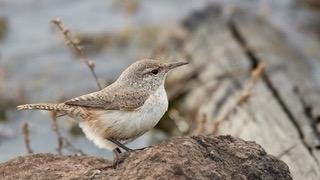
Rock Wren, note buffy flanks and pale line through the eye. Theoverall color is that of dull buffy brown.
The Rock Wren is mostly gray-brown with fine pale speckling across the back. The underparts are pale buff, that can stand out, with light spotting on the breast. The overall impression is soft gray-brown that blends remarkably well with weathered rocks.
The Canyon Wren is much richer in color. Its back is a warm reddish-brown or chestnut, while the underparts are bright cinnamon or rusty orange. The throat is strikingly white,creating one of its best field marks. Even from a distance, Canyon Wrens often appear warmer and more colorful than Rock Wrens.This is the Canyon Wren. Note the bright white, lack of an eyeline and the deep chestnut on body and tail.
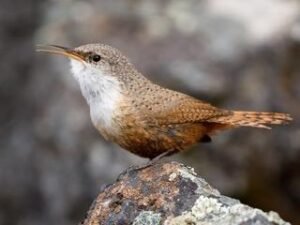
This is the Canyon Wren. Note the bright white, lack of an eyeline and the deep chestnut on body and tail.
Face Pattern
Rock Wren
- The face is fairly plain.
- Thin pale eyebrow
- Grayish cheeks
- Little contrast
Canyon Wren
- Stronger face pattern
- Bright white throat, this is a good field mark
- White eyebrow, much brighter than the Rock Wren
- Rich chestnut face
- Strong contrast between throat and face
- This white throat often catches sunlight and is visible from surprising distances
Tail Pattern
Rock Wren
When it spreads its tail, the outer tail feathers show distinct black-and-white barring and white corners. This pattern flashes as the bird flies between rocks.
Canyon Wren
The Canyon Wren lacks this bold black-and-white tail pattern. Its tail appears mostly rusty or cinnamon, with subtle barring rather than bold white flashes.
Behavior
Rock Wren
Rock Wrens spend much of their day hopping across open rocks. They pause frequently, stand upright, bobs slightly, and flick their tails. They often forage in the open, searching every crack, pebble, and crevice. Unlike many wrens, Rock Wrens are surprisingly willing to perch on exposed boulders where they can be easily observed.
Canyon Wren
Canyon Wrens behave more like tiny mountaineers. They cling to nearly vertical cliffs with ease. Instead of hopping across open ground, they creep along rock faces, probing narrow cracks with their curved bills.
Watching one move effortlessly over a sheer cliff is unforgettable.
Habitat Differences
Rock Wren Habitat
If the landscape is rocky but fairly open, a Rock Wren is the more likely species.
Canyon Wren Habitat
If you are standing among rocky canyons with vertical cliffs, Canyon Wrens are a good bet.
Songs: The Best Identification Tool
Canyon Wren Song
The Canyon Wren possesses one of North America’s most beautiful bird songs. It begins with a few clear notes before cascading downward in a long series of rich, musical whistles. The song often echoes dramatically through narrow canyons. To me it sounds like the bird is singing “Way down the Canyon”. Once you hear it, you won’t forget it.
Rock Wren Song
The Rock Wren sings a much different song. Its performance consists of clear whistles, trills, and short phrases that vary considerably between individuals. Rather than flowing downward, the song sounds like a cheerful series of separate musical phrases. It sounds more like a typical “wren song” Learning these songs may allow you to identify the birds without ever seeing them.
Nesting
Rock Wrens often nest inside cavities beneath rocks or inside crevices. A fascinating behavior is that they build small stone walkways leading to the nest entrance. Look carefully and see if you can spot this. Canyon Wrens also nest inside rocky crevices but typically choose deep cracks in cliff walls that offer protection from predators.
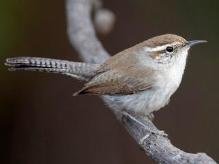
Don’t confuse these two with Bewick’s wren. Note lack of deep chestnut of the Canyon Wren and the bright eyeline of the Bewick’s compared to the Rock Wren.
Seasonal Occurrence
Rock Wrens migrate in much of the northern part of their range. They may disappear during winter from higher elevations and northern deserts. Canyon Wrens are more sedentary and often remain in suitable canyon habitats throughout the year.
Similar Species
Beginning birders are most likely to confuse these species with Bewick’s Wrens. Bewick’s Wrens show a long white eyebrow and occur around shrubs, woodland edges, and suburban areas, not the rocky areas and cliffs of these other two species. Sometime Bewick’s and Rock Wren habitat can overlap. Look closely, and note that the Rock Wren lacks the bright eyeline of the Bewick’s.
Quick Comparison
|
Feature |
Rock Wren |
Canyon Wren |
|---|---|---|
|
Overall color |
Gray-brown |
Rich reddish-brown |
|
Throat |
Pale buff |
Bright White |
|
Underparts |
Buff with spotting |
Rich cinnamon |
|
Bill |
Straight |
Long and curved |
|
Tail |
Short with white corners |
Longer, mostly rusty |
|
Habitat |
Open rocky terrain |
Vertical cliffs and canyons |
|
Song |
Whistles and trills |
Descending musical cascade |
Final Thoughts
Many beginning birders initially worry about separating Rock Wrens from Canyon Wrens, but these species become remarkably easy once you combine several identification clues. Start by observing the habitat. Is the bird exploring open boulders or clinging to a sheer cliff? Next, note its overall color—gray-brown suggests Rock Wren, while rich cinnamon with a gleaming white throat points to Canyon Wren. Finally, learn the songs: the Rock Wren’s varied whistles differ dramatically from the Canyon Wren’s unforgettable, cascading melody.
So where can we see these guys?
These birds aren’t everywhere. Good places to spot Rock Wren include:
• Sunol Regional Wilderness: Look along the Alameda Creek gorge on the Ohlone trail especially on the rocky formations around the Alameda Creek Overlook.
• Del Valle Regional Park: Check rocky slopes above the East Shore trail. There are two spots that have worked for me in the past. First are the rocky outcrops along the Miwok Trail at Round Valley Regional Preserve. The second spot has worked for me 100% of the time and that is the cisterns along the trail to Point Reyes Lighthouse.
For Canyon Wren:
• Riggs Canyon (Mount Diablo State Park): Riggs Canyon in Mount Diablo State Park is widelyregarded as the most reliable and accessible location in the East Bay. The birds breed on the steep rocky cliffs just beyond the entrance gate.
• Canyon Wrens have also been reported along Alameda Creek in Sunol but I have never seen or heardthem there. Sunol gives you a chance to see both these species in one trip. Mitchell Canyon and Rock City in Mount Diablo State Park are also good bets.
If you are willing to drive a bit to see these guys, reliable sites are Pinnacles National Park and Monticello Dam on Lake Berryessa, near Winters.