Surf, White-winged, and Black Scoters
Scoters are among the most distinctive—and most frustrating—ducks a birder encounters. They are large, dark sea ducks that spend much of their lives on cold northern waters and the ocean, often far enough offshore that even good binoculars leave you looking at little black blobs. Yet, the San Francisco Bay Area is one of the best places in North America to study them. During fall and winter, thousands of scoters gather on the Bay, often in mixed flocks containing Surf, White-winged and, occasionally, Black Scoters.
Learning to identify them is worthwhile because scoters illustrate one of the most important lessons in bird identification: don’t begin with color alone. Start with size, shape, bill structure, head pattern, behavior, habitat, and—when possible—flight characteristics.
The three species belong to the diving-duck tribe Mergini. All are powerful swimmers and divers, with dense plumage that insulates them from cold water. They typically feed on mollusks and other aquatic invertebrates, diving beneath the surface using their bills to capture or pry loose prey.
Scoters and the San Francisco Bay
The Bay is particularly important winter habitat for diving ducks. Historically, nearly half of the Surf Scoters wintering in the lower Pacific Flyway occurred here. Today, however, diving-duck numbers have declined in parts of the Bay, particularly the North and Central Bay. The current San Francisco Bay State of the Birds assessment reports that diving-duck trends are relatively stable overall but differ substantially among regions.
Surf Scoters are by far the most likely of the three to be encountered regularly in the Bay. White‑winged Scoters are less numerous, while Black Scoters are distinctly uncommon in most Bay Area locations. That difference in abundance is itself useful when evaluating an unfamiliar bird—but it should never be used to dismiss an unusual-looking individual.
Scoters favor relatively deep, open water and areas where shellfish are abundant. In the Bay, they can form large rafts that seem to disappear and reappear as individual birds dive. Rocky coastlines, marinas, bridges, and sheltered bays can also provide good viewing.
Among productive Bay Area locations are Coyote Point, Richardson Bay, San Leandro Marina, and various shoreline viewpoints overlooking deeper water. Coyote Point is particularly useful because Surf Scoters can sometimes be viewed relatively close to shore.
Richardson Bay deserves special attention. Its extensive protected subtidal waters provide important winter habitat for waterbirds, including Surf Scoters, and the area is particularly valuable during the winter period.
Surf Scoter
Scientific name: Melanitta perspicillata
For most Bay Area birders, Surf Scoter is the scoter to learn first. It is the most numerous scoter in the region and, fortunately, the adult male is one of the easiest sea ducks to recognize once you know what to look for.
Adult male
The male Surf Scoter is essentially black, but his head contains three striking areas of white: a large patch on the forehead, another at the rear of the head or nape, and a smaller white area near the bill. His enormous, colorful bill is the real showstopper. It is orange, white, and black and has a distinctly swollen, sloping profile.
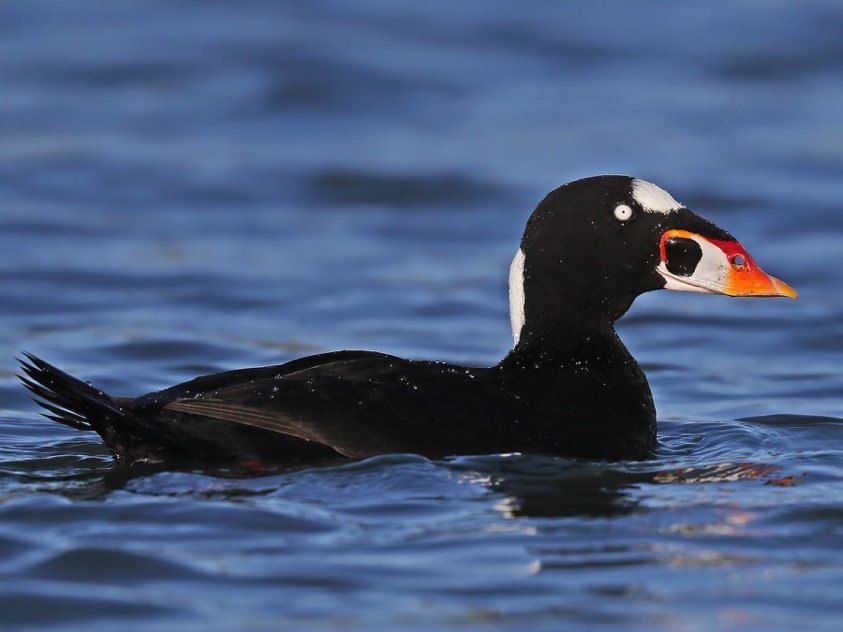
Think:
black body + white face patches + huge orange bill = Surf Scoter.
The bill is especially important. At a distance, the white patches can blend together or disappear in poor light, but the large, orange, swollen bill often remains apparent.
The male’s spectacular appearance has earned the species the informal nickname “skunkhead,” a reference to the contrasting white markings on its black head.
Female and immature Surf Scoters
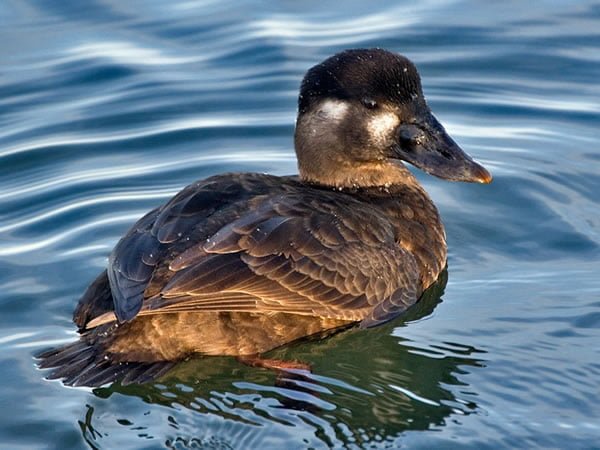
Female Surf Scoters are much harder.
They are dark or sooty brown, with a dark bill and two pale facial patches. One patch is generally near the base of the bill and another is farther back on the cheek or behind the eye.
This creates a useful distinction from female White-winged Scoters, but the differences can be subtle. A female Surf Scoter should look dark overall, with a relatively large head and bill and two distinct pale facial areas.
Don’t expect every female to display a textbook pattern. Lighting, distance, molt, age, and the angle of the bird can dramatically alter its appearance.
White-winged Scoter
Scientific name: Melanitta deglandi
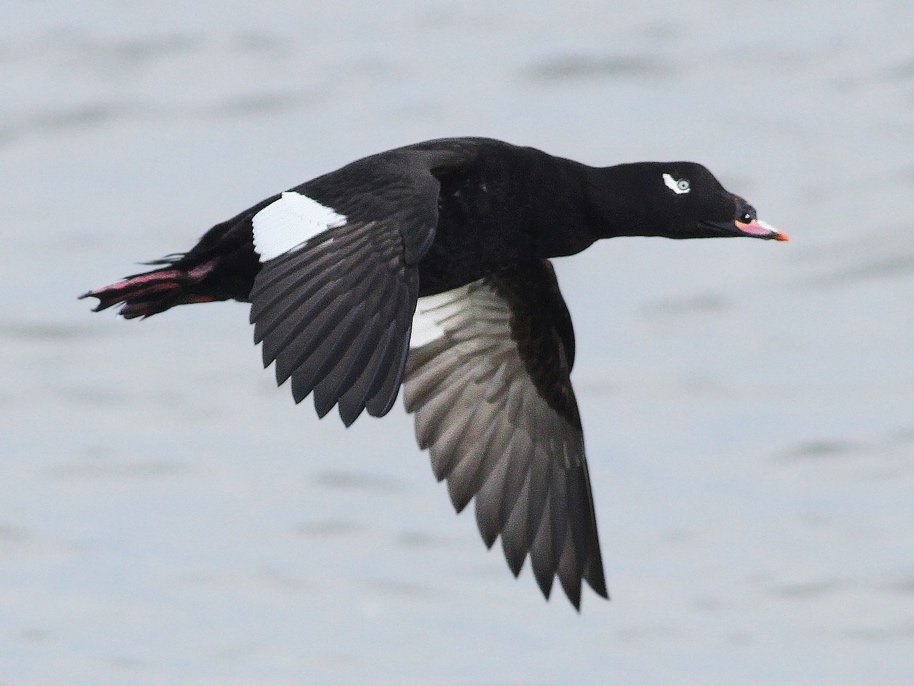
The White-winged Scoter is the largest of the three North American scoters and, in some ways, the easiest to identify—if you can see the wing.
Adult male
The male is velvety or silky black with three especially useful features:
- a large white wing patch;
- a small, comma-shaped white mark around and behind the eye;
- an orange-tipped bill with black at its base.
The wing patch is the key. When the bird is sitting on the water, the white wing patch may be almost completely hidden. When it stretches its wings or flies, however, the white becomes unmistakable.
This creates one of the great scoter identification traps: a White-winged Scoter swimming among Surf Scoters may look almost entirely black.
Consequently, don’t identify every black scoter as a Surf Scoter simply because you cannot see a white wing patch.
The White-winged Scoter is noticeably larger and heavier than Surf and Black Scoters. Its head and bill also appear substantial.
Female and immature birds
Females and young White-winged Scoters are dark brown rather than black. They have pale facial markings and can look remarkably similar to female Surf Scoters.
The best clue is again the white wing patch.
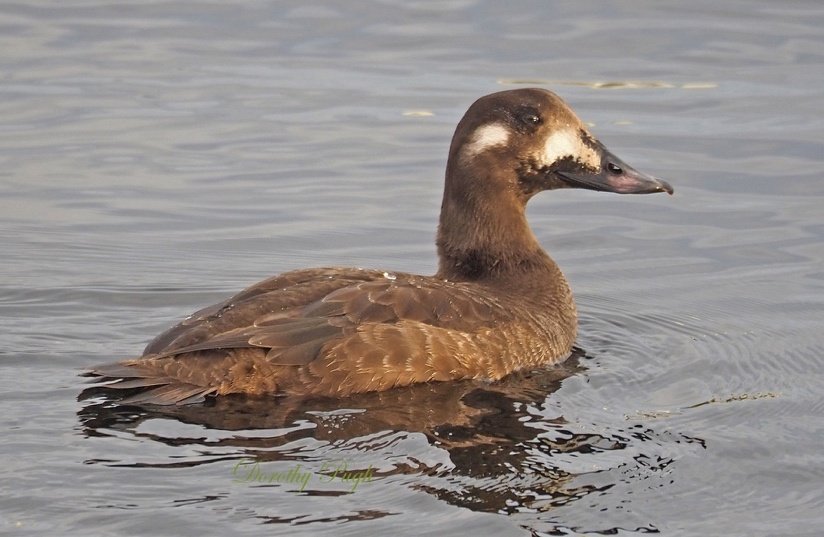
If a brown scoter suddenly raises its wings and reveals a broad white panel, you have aWhite-winged Scoter.
When the bird remains motionless, however, identification can become much more difficult. In these circumstances, compare overall size, head shape, bill structure, and facial pattern rather than relying on a single field mark.
Black Scoter
Scientific name: Melanitta americana
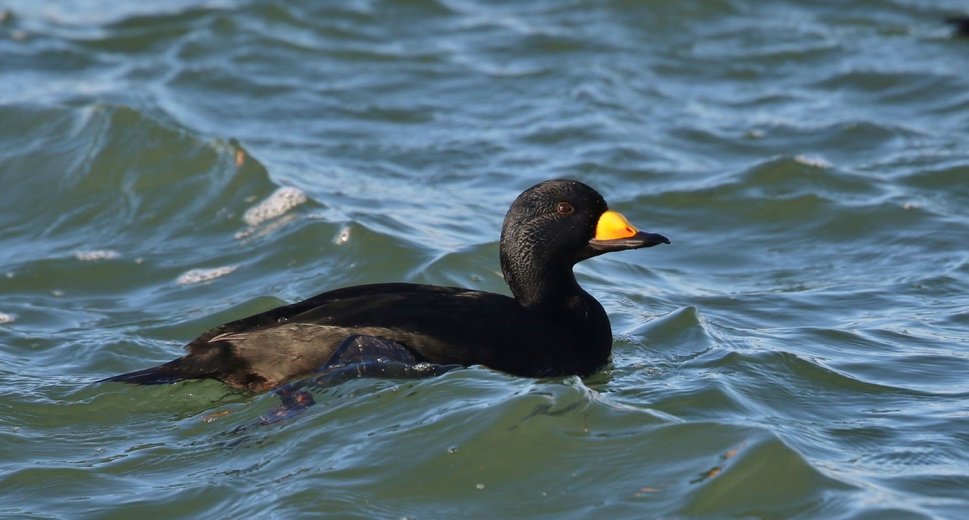
Black Scoter is the least frequently encountered of the three in the San Francisco Bay Area and, therefore, can be an exciting find.
The adult male is almost entirely black, with one major exception: a bright orange knob at the base of the bill.
Unlike the Surf Scoter, the Black Scoter does not have the dramatic white facial markings. Unlike the White-winged Scoter, it does not have a conspicuous white wing patch.
That leaves you with a very simple-looking black duck.
But the bill tells the story.
Adult male
Look for:
all-black body + rounded head + orange bill knob.
The bill itself is relatively broad, and the profile is different from the Surf Scoter’s enormous, sloping bill. The Black Scoter’s bill does not slope upward toward the forehead as strongly as the Surf Scoter’s does.
The Black Scoter also tends to look somewhat smaller and more compact than a White-winged Scoter.
Female and immature birds
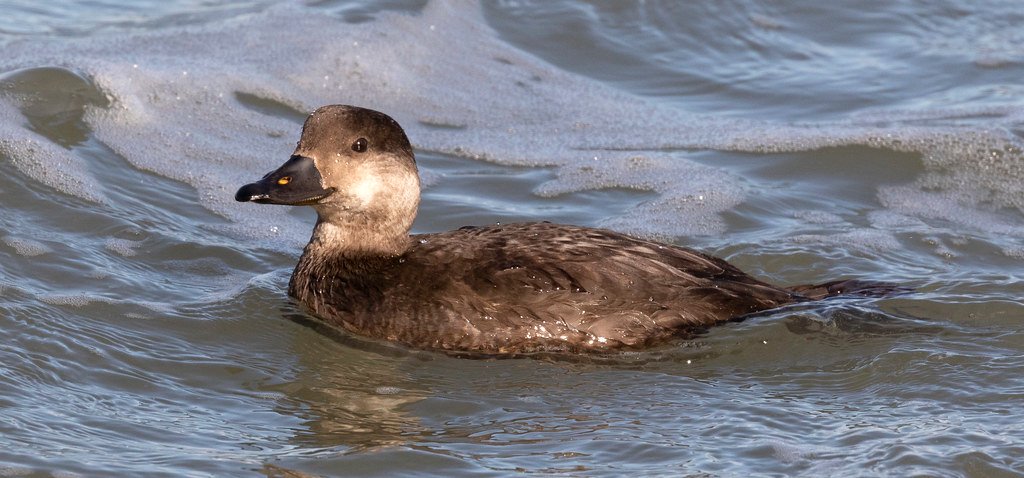
These are considerably more difficult. Females and young birds are brown, with a paler cheek and darker cap. They can overlap considerably in appearance with female Surf and White-winged Scoters.
This is where the combination of characteristics becomes important:
Surf Scoter female: two pale facial patches, relatively large sloping bill.
White-winged Scoter female: brown overall, pale face, but look for the white wing patch.
Black Scoter female: brown with pale cheek, relatively rounded head, and no white wing patch.
The Black Scoter also tends to sit relatively buoyantly, sometimes with the tail noticeably cocked upward.
How to Identify a Scoter in the Bay
When you encounter a distant flock of dark ducks, resist the temptation to immediately name the species.
Use this sequence.
1. Is it actually a scoter?
Scoters are chunky, heavy-bodied diving ducks. They sit relatively low in the water, have short tails, and often form tight groups.Don’t confuse them with Greater Scaup, which are common in the Bay and can also form enormous rafts.
2. Look at size
If one bird seems noticeably larger than the others, investigate it.
Largest: White-winged Scoter
Intermediate: Surf Scoter
Smallest: Black Scoter
Size differences are easier when species are sitting together.
3. Find the males
Adult males are much easier.
Look for:
Huge orange bill and white face → Surf
White wing patch and white eye mark → White-winged
Plain black with orange bill knob → Black
4. Wait for movement
This is especially important with White-winged Scoters.
A bird sitting on the water may hide its most important field mark. Wait for it to flap, stretch, preen, or fly.
A flock taking flight can suddenly reveal several White-winged Scoters that were nearly invisible moments earlier.
5. Study the bill
For close birds, bill shape may be more useful than plumage.
Surf Scoter has the most extravagant bill: large, swollen, and strongly sloping.
White-winged Scoter has a heavy bill with an orange tip.
Black Scoter has a more compact-looking bill with a rounded orange knob in the male.
6. Watch the flock
Scoters are social, and mixed flocks are common.
If you identify one Surf Scoter, don’t stop. Search the rest of the flock. You may find White-winged Scoters mixed among them—and occasionally a Black Scoter.
This is one reason scoter identification is an excellent exercise in careful scanning rather than simply checking off the first recognizable bird.
Where to find these guys
The best time to look for scoters around San Francisco Bay is generally late fall through winter and into early spring, when northern breeders are occupying their coastal wintering grounds.
Bring a spotting scope if possible. Binoculars are sufficient for close birds, but a scope can transform a distant raft of black dots into an extraordinarily interesting collection of individual ducks.
Coyote Point is a particularly useful location because Surf Scoters may occur relatively close to shore. Richardson Bay is another excellent place to learn the birds while also seeing the broader community of wintering waterfowl.
Watch a flock for ten or fifteen minutes. Notice how often individuals dive. Watch birds preen and stretch. Study their size relationships. Eventually, the differences that initially seemed impossibly subtle begin to become obvious.
A Simple Field Comparison
| Feature | Surf Scoter | White-winged Scoter | Black Scoter |
| Overall size | Medium-large | Largest | Smaller |
| Male body | Black | Silky black | Black |
| Male face | White patches | White comma behind eye | Plain black |
| Male bill | Large, orange, multicolored | Heavy, orange-tipped | Orange knob |
| White wing patch | No | Yes | No |
| Female | Brown, two pale face patches | Brown, pale face | Brown, pale cheek |
| Best clue | Huge colorful bill and white head patches | White wing patch | Orange bill knob |
| Bay Area abundance | Commonest | Less common | Uncommon |
| Typical winter habitat | Bay, coast, open water | Bay and coast | Coastal waters |
The Most Important Lesson
The three scoters become much easier when you stop trying to memorize isolated field marks.
Think of them as three combinations:
Surf Scoter = spectacular face and spectacular bill.
White-winged Scoter = big bird with white in the wing.
Black Scoter = plain black male with an orange bill knob.
For females and immature birds, slow down. Use size, head shape, bill shape, facial pattern, and—above all—the white wing patch of the White-winged Scoter.
Finally, remember that San Francisco Bay is not merely a convenient place to practice identifying these birds. It is an important part of their winter ecology. Scoters connect the Bay to northern breeding lakes, Pacific coastal ecosystems, shellfish beds, eelgrass, and even Pacific herring spawning areas. Their presence—and changes in their abundance—can tell us something about the health of the estuary itself.
For birders, few experiences are more satisfying than looking at a distant flock that once appeared to contain nothing but black ducks and gradually realizing it contains three different species, each with its own distinctive story.